Blood Cells

Blood cells on a peripheral blood smear illustrating erythrocytes, neutrophils, lymphocytes, monocytes, and platelets in normal hematology
Blood cells are the fundamental cellular components studied in hematology and play a vital role in maintaining oxygen delivery, immune defense, and hemostasis. All blood cells originate in the bone marrow from hematopoietic stem cells through a tightly regulated process known as hematopoiesis, leading to the formation of three main blood elements: red blood cells (RBCs), which are responsible for oxygen transport; white blood cells (WBCs), which provide immune protection against infections and malignancy; and platelets, which are essential for normal blood clotting and vascular integrity. A clear understanding of blood cells, their functions, and their life cycle is essential for the accurate diagnosis, classification, and management of a wide range of hematological disorders.

Blood cells originate from hematopoietic stem cells, shown here on electron microscopy illustrating early cellular structure in hematopoiesis.
Blood cell development in the human embryo, also known as embryonic hematopoiesis, occurs in distinct waves and anatomical sites. The earliest blood cells arise in the yolk sac around the third week of gestation, producing primitive erythrocytes to meet the embryo’s oxygen demands. By the fifth to sixth week, hematopoietic stem cells migrate to the fetal liver, which becomes the major site of blood cell production during mid-gestation. As development progresses, the spleen and thymus also contribute to hematopoiesis. Finally, by the third trimester, the bone marrow is established as the permanent site of blood cell formation, continuing throughout life. This stepwise transition ensures that the growing fetus has adequate red cells, white cells, and platelets at different stages of development.
The average human adult has more than 5 litres of blood in his or her body. Blood carries oxygen and nutrients to living cells and takes away their waste products. It also delivers immune cells to fight infections and contains platelets that can form a plug in a damaged blood vessel to prevent blood loss.
Through the circulatory system, blood adapts to the body’s needs. When you are exercising, your heart pumps harder and faster to provide more blood and hence oxygen to your muscles. During an infection, the blood delivers more immune cells to the site of infection, where they accumulate to ward off harmful invaders.
All of these functions make blood a precious fluid. Each year in the USA, 30 million units of blood components are transfused to patients who need them. Blood is deemed so precious that is also called “red gold” because the cells and proteins it contains can be sold for more than the cost of the same weight in gold.
If a test tube of blood is left to stand for half an hour, the blood separates into three layers as the denser components sink to the bottom of the tube and fluid remains at the top.
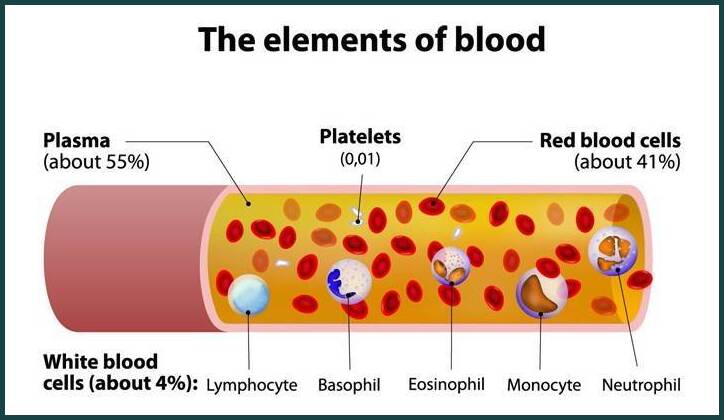
Blood cells and plasma illustrated in a schematic diagram showing red blood cells, white blood cells subtypes, platelets, and their relative proportions in circulating blood.
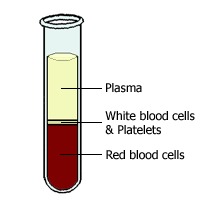
Blood components after centrifugation showing plasma at the top, buffy coat containing white blood cells and platelets, and red blood cells at the bottom.
The straw-colored fluid that forms the top layer is called plasma and forms about 55% of blood. The middle white layer is composed of white blood cells (WBCs) and platelets, and the bottom red layer is the red blood cells (RBCs). These bottom two layers of cells form about 45% of the blood.
Plasma is mainly water, but it also contains many important substances such as proteins (albumin, clotting factors, antibodies, enzymes, and hormones), sugars (glucose), and fat particles.
All of the cells found in the blood come from bone marrow. They begin their life as stem cells, and they mature into three main types of cells:
- Red blood cells (RBCs) – Erythrocytes
- White blood cells (WBCs) – Leucocytes
- Platelets – Thrombocytes
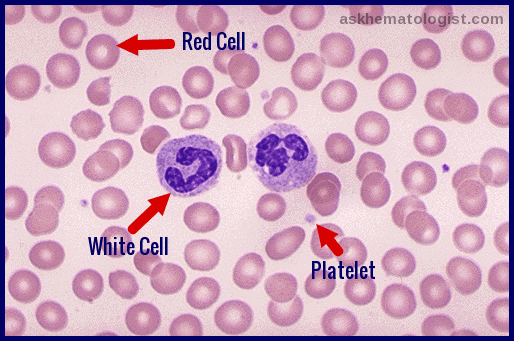
Blood cells on a peripheral blood smear highlighting a red blood cell, a white blood cell, and a platelet as seen in routine hematology.
In turn, there are three types of WBC—lymphocytes, monocytes, and granulocytes—and three main types of granulocytes (neutrophils, eosinophils, and basophils).
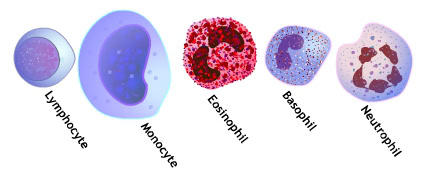
White blood cells as part of blood cells, showing lymphocyte, monocyte, eosinophil, basophil, and neutrophil morphology.
Together, these three kinds of blood cells add up to a total of 45% of the blood tissue by volume, with the remaining 55% of the volume composed of plasma, the liquid component of blood. This volume percentage hematocrit is measured by centrifuge or flow cytometry and is 45% of cells to the total volume in males and 40% in females.
Hemoglobin (the main component of red blood cells) is an iron-containing protein that facilitates the transportation of oxygen from the lungs to tissues and carbon dioxide from tissues to the lungs.
A sample of blood can be further separated into its components by spinning the sample in a centrifuge. The force of the spinning causes denser elements to sink, and further processing enables the isolation of a particular protein or the isolation of a particular type of blood cell. With the use of this method, antibodies and clotting factors can be harvested from the plasma to treat immune deficiencies and bleeding disorders, respectively. Likewise, RBCs can be harvested for blood transfusion.
Red Blood Cells (Erythrocytes):
What are red blood cells?
Red blood cells, or erythrocytes, give blood its distinctive color and make up about 40-45% of blood’s volume. Red blood cells are produced in our bone marrow where they typically live for about 120 days. The red blood cell’s main function is to carry oxygen from the lungs and deliver it throughout our body. Red blood cells also transport waste such as carbon dioxide back to our lungs to be exhaled. Red blood cells can carry oxygen due to a protein called hemoglobin. Hemoglobin is made of two main parts: the “heme” group and the “globin” group. The heme group contains iron which gives the red color to the red blood cell. The globin group is a protein that helps the red blood cell carry and hold oxygen in place as it moves throughout the body.
How are red blood cells used?
Certain conditions within our bodies may trigger the production of red blood cells. For example, if our body doesn’t have enough blood cells or our body tissue lacks oxygen. Then a hormone called erythropoietin will stimulate the bone marrow to produce more red blood cells.
However, there are instances where our body cannot produce enough red blood cells to meet the demands our body needs. If the number of blood cells is too low, this is known as anemia. When a person is anemic, their blood carries less oxygen throughout the body, which may result in fatigue and weakness. Having a low number of red blood cells could be a result of trauma, surgery, blood loss or blood disorders such as sickle cell disease.
Red blood cell donations are important to help patients who cannot produce enough red blood cells.

Blood cells prepared for transfusion showing packed red blood cell units used in clinical hematology and transfusion medicine.
White Blood Cells (Leukocytes):
What are white blood cells?
White blood cells, or leukocytes, are part of the body’s immune system, where there is one white blood cell for every 600 to 700 red blood cells. The white blood cell’s main function is to help fight infections. Most of our white blood cells are individualized to our specific bodies, which is why white blood cells are removed from transfusable blood. Removing the white blood cells from transfusable blood is known as leuko-reduction, which prevents the blood from causing a negative reaction during donation.
There are five main types of white blood cells:
Lymphocytes: Help the body make cells that fight against infection and make antibodies.
Monocytes: Help other white blood cells remove damaged tissue and gobble up bacteria, viruses, debris and infectious organisms.
Eosinophils: Kill parasites, destroy cancer cells and help the immune system with an allergic response.
Basophils: Release histamine if there is an allergic reaction; help prevent blood clots.
Neutrophils: Help heal damaged tissue and resolve an infection.
How are White Blood Cells Used?
The list of white blood cells mentioned is broken up into two categories: granulocytes and agranulocytes. The agranulocytes are the lymphocytes and monocytes. The granulocytes include eosinophils, basophils and neutrophils.
In the USA, the Red Cross collects granulocytes to help treat infections that don’t respond to antibiotics. This process is known as apheresis and the cells must be transfused to the patient within 24 hours of donation. Donated granulocytes are collected on an as-needed basis. To be eligible to donate granulocytes, you must have donated platelets through the Red Cross within the past 30 days.
Platelets (Thrombocytes):
What are platelets?
Platelets, or thrombocytes, are tiny blood cells that can only be seen under a microscope. They are made from the spongy center inside our bones known as bone marrow. Platelets typically live for about 8 to 10 days in our body. A platelet’s main function is to rush to an injury in the blood vessel and form a plug to fix the damage. This plug is known as a clot, or thrombus, which helps prevent blood loss.
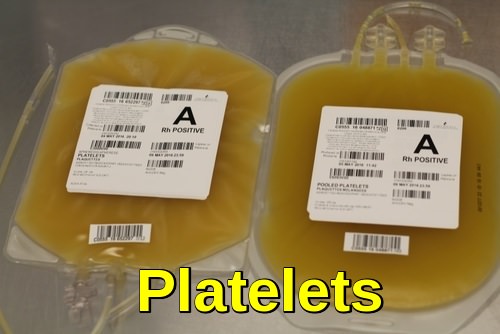
Blood cells transfusion showing platelet concentrate units prepared for clinical use in hematology.
However, there are conditions where the body may produce too little or too many platelets. Too many platelets are known as thrombocythemia, where there is excessive clotting. When there are too few platelets in the blood this is known as thrombocytopenia, where bruising and abnormal bleeding become more likely.
How Are Platelets Used?
Because platelets help control bleeding, they are mainly used for cancer treatments, organ transplants, surgeries, and platelet dysfunctions. Platelets can be extracted from a whole blood donation using a centrifuge or they can be collected using an automated process. This process allows, one donor to contribute four to six times as many platelets as platelets collected from a whole blood donation. And because platelets need to be used within five days of donation, there is a constant need for platelet donors!
Questions and Answers:
What are blood cells and why are they important?
Blood cells are the cellular components of blood that include red blood cells, white blood cells, and platelets, each performing essential functions such as oxygen transport, immune defense, and blood clotting, making them critical for survival and overall health.
Where are blood cells produced in the body?
Blood cells are produced in the bone marrow from hematopoietic stem cells through a regulated process called hematopoiesis, which continuously replenishes circulating blood cells throughout life.
What are the main types of blood cells?
The three main types of blood cells are red blood cells responsible for oxygen transport, white blood cells involved in immune protection, and platelets which play a key role in hemostasis and prevention of bleeding.
What is the function of red blood cells?
Red blood cells carry oxygen from the lungs to tissues via hemoglobin and facilitate carbon dioxide transport back to the lungs, making them essential for cellular metabolism and energy production.
What are white blood cells and what do they do?
White blood cells are immune cells that protect the body against infections, inflammation, and malignancy, and include neutrophils, lymphocytes, monocytes, eosinophils, and basophils, each with specialized functions.
What are platelets and why are they important?
Platelets are small blood cell fragments that play a central role in blood clotting, helping to stop bleeding and maintain vascular integrity following injury.
What is seen on a peripheral blood smear?
A peripheral blood smear allows microscopic examination of blood cells, showing red blood cells, white blood cell subtypes, and platelets, and is essential for diagnosing anemia, infections, leukemias, and platelet disorders.
What is the buffy coat in centrifuged blood?
The buffy coat is the thin layer between plasma and red blood cells after centrifugation, containing white blood cells and platelets, and is useful in laboratory analysis and blood component separation.
What are hematopoietic stem cells?
Hematopoietic stem cells are primitive bone marrow cells capable of self-renewal and differentiation into all blood cell lineages, forming the foundation of normal blood formation.
How are blood cells used in transfusion medicine?
Blood cells are separated into components such as packed red blood cells and platelet concentrates for transfusion, allowing targeted treatment of anemia, bleeding, and hematological disorders.
References:
Dean L. Blood and the Cells It Contains – Blood Groups and Red Cell Antigens. Bethesda (MD): National Center for Biotechnology Information (US); 2005. NCBI Bookshelf.
Palis J., Yoder MC. “Yolk-Sac Hematopoiesis: The First Blood Cells of Mouse and Man.” Exp Hematol. 2001;29(8):927-936. DOI:10.1016/S0301-472X(01)00669-5.
Bain BJ., Bates I., Laffan M., Lewis SM. (eds). Dacie and Lewis Practical Haematology. 11th ed. Elsevier Health Sciences, London; 2012. ISBN: 9780702034084.
Arceci RJ., Hann IM., Smith OP. (eds). Pediatric Hematology. 3rd ed. Blackwell Publishing, London; 2012. ISBN: 9781405134002.
American Red Cross. “What Do Blood Cells Do?” AmericanRedCross.org.
National Heart, Lung, and Blood Institute (NHLBI). “Treatments for Blood Disorders.” NHLBI.gov.
Keywords:
blood cells in hematology, types of blood cells, red blood cells functions, white blood cells types and roles, functions of red white cells and platelets, platelets in hematology, blood cell disorders overview, blood cell morphology, abnormal blood cells list, hematology blood cell types functions, blood smear normal blood cells, blood cell count significance, blood cell lifespan red white platelet, blood cell disorders diagnosis, blood cells and hematologic diseases, embryonic hematopoiesis, blood cell development in human embryo, stages of blood cell development embryo, yolk sac hematopoiesis, fetal liver hematopoiesis, spleen hematopoiesis embryo, bone marrow hematopoiesis development, hematopoietic stem cell migration embryo, prenatal blood cell formation, embryonic blood development

Related Posts:



Request Online Consultation With Dr M Abdou
Fee: US$100
Secure payment via PayPal (credit and debit cards accepted)
Pay Now
In a blood test result, what does a high percentage B cells, a low NK cell function and Low IgG mean? Also Pneumococcal IgG results are L for 10 of the 14.
Hi Heila,
Thanks for your comment.
Which blood test have you had, blood flow cytometry?