Primary Myelofibrosis
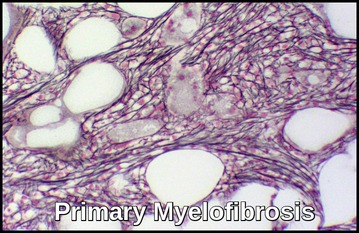
Primary myelofibrosis bone marrow showing marked reticulin fibrosis with distorted architecture.

Primary myelofibrosis (PMF) is a chronic myeloproliferative neoplasm characterized by progressive bone marrow fibrosis, extramedullary hematopoiesis, massive splenomegaly, and anemia often accompanied by nucleated red cells and teardrop-shaped erythrocytes. As the spleen and liver enlarge due to compensatory hematopoiesis, patients may develop abdominal discomfort, infarction, portal hypertension, hypersplenism, plasma volume expansion, and an increased risk of splanchnic vein thrombosis. These […]

Read more

Essential Thrombocythemia

Bone marrow smear showing large mature megakaryocytes in Essential Thrombocythemia.

Essential thrombocythemia (ET) is a myeloproliferative neoplasm (MPN) characterized by megakaryocyte hyperplasia and thrombocytosis due to a multipotent hematopoietic stem cell clonal abnormality. From the genetic perspective, ET patients harbour mutations in JAK2 (50–60%), CALR (15–30%) and MPL (1–5%) genes. Platelet survival is normal in ET. Approximately one-third of patients with ET are asymptomatic at diagnosis. ET usually occurs with bimodal […]

Read more

Polycythemia Rubra Vera

Polycythemia Rubra Vera showing plethoric skin, hepatosplenomegaly, and hypercellular bone marrow biopsy

Polycythemia Rubra Vera (PRV) is a chronic myeloproliferative neoplasm characterized by an increased red blood cell (RBC) production and RBC mass often manifested as an increased hematocrit (Hct).  There is a malignant transformation of the multipotential stem cell with excess production of red blood cells in the bone marrow and blood, causing the blood to thicken. The number of white […]

Read more

Chronic Myeloid Leukemia

Philadelphia chromosome in chronic myeloid leukemia showing t(9;22) BCR-ABL1 translocation

Chronic myeloid leukaemia (CML), also known as chronic myelogenous leukaemia, is a clonal myeloproliferative neoplasm driven by the BCR-ABL1 fusion (Philadelphia chromosome), resulting in uncontrolled proliferation of the granulocytic lineage while preserving normal maturation. It typically presents in the chronic phase but may progress to accelerated or blast phase if untreated. CML is classified under ICD-10 code C91.10. Aetiology: In […]

Read more